























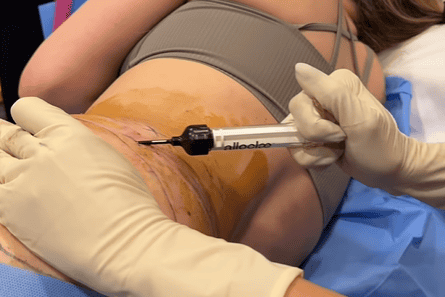
AlloClae vs. Fat Transfer: The Retention Rate Conversation
If you’re researching AlloClae body contouring, comparing AlloClae vs fat transfer, or searching “how long does AlloClae last,” what you really want to know is this:
Will my results last – and how predictable are they?
At NicholsMD of Greenwich, this is one of the most important distinctions we discuss during body contouring consultations.
What Is AlloClae?
AlloClae is a structural adipose allograft designed to restore volume and correct contour irregularities without liposuction.
It is commonly used to treat:
- Hip dips
- Buttock contour irregularities
- Post-liposuction depressions
- Volume loss, often associated with patients on their GLP-1 journey
- Non-surgical body contour refinement
Unlike traditional fat transfer, AlloClae does not require harvesting your own fat. It is injection-based and designed to integrate structurally within the tissue.
How Long Do AlloClae Results Last?
In our clinical experience, AlloClae is designed for long-lasting structural correction, with results commonly maintained for 12 to 18 months or longer, depending on the treatment area and individual factors.
But the real reason AlloClae has gained so much attention is retention rate.
AlloClae vs Fat Transfer: The Retention Difference
Traditional fat transfer has decades of data showing that long-term retention is variable. On average, published literature commonly reports approximately 45–65% retention of transferred fat over time.
This variability occurs because fat grafting depends on live fat cells surviving after transplantation. Some cells successfully establish blood supply, while others do not. That, accompanied with the amount of liquid injected and then absorbed during transfer, is why volume loss is expected.
AlloClae functions differently.
Because it is processed to preserve structural adipose matrix components rather than relying solely on fragile transplanted fat cell survival, it has been frequently described in clinical use as demonstrating approximately 90% or greater retention of injected volume, with some reporting that nearly all of what is placed remains long term.
While large-scale imaging trials are still evolving, the consistency of high retention observed in practice is one of the reasons AlloClae has become a game changer not only here at NicholsMD, but in aesthetic medicine as a whole.
The difference between ~50% average retention and ~90% reported retention is substantial. And in body contouring, predictability matters.
Why Retention Rate Is So Important
When retention is lower:
- Volume may decrease over time
- Additional procedures may be needed
- Outcomes can be less predictable
When retention is higher:
- Volume correction is more stable
- Treatment planning is more precise
- Results are more consistent
For patients seeking non-surgical body contouring, hip dip correction, or buttock contour refinement without liposuction, that predictability is often the deciding factor.
Is AlloClae Better Than Fat Transfer?
The answer depends on your goals. AlloClae is often preferred for:
- Lean patients without harvestable fat
- Patients seeking smaller-volume refinement
- Correction of contour irregularities
- A minimally invasive approach
- Greater predictability in retention
The Bottom Line
Traditional fat transfer typically retains around 45–65% of transferred volume over time.
AlloClae has been widely described in clinical use as demonstrating ~90% or greater retention, offering a potentially more predictable, long-lasting solution for structural body contour correction.
If you’re searching for:
- Long-lasting body contouring
- Non-surgical fat transfer alternatives
- AlloClae near me
- Hip dip treatment without surgery